Genesis 22:1
“After these things, God tested Abraham and said to him, ‘Abraham!’ And he said, ‘Here I am.’”
Last Monday, I spoke about the payoff of Dorothy’s ruby-red slippers in the Wizard of Oz. It was planted early in the movie before becoming the secret ticket back to Kansas. The audience had all it needed before the final scene. The solution was right before our eyes. And, so often, this is true in God’s unfolding salvation in Scripture.
Abraham was called by God in Genesis 12. He was the beginning of the ancestral history of the Chosen People. And, as I’ve shared before, Abraham comes on the scene in the aftermath of the Tower of Babel. Abraham is God’s act of grace. Through Abraham and Sarah (and their family lineage), God will bring back together all those who were separated as languages confused the world’s population. In essence, the people tried to climb their way up to God. But God has always been the one who comes to us. We don’t rise up—He comes down. And Abraham is the first patriarch of this ancestral history. He is the one who begins God’s journey to draw us back.
And, like Dorothy’s shoe, we see the final act early in the story.
Today’s verse is the beginning of a really hard and challenging chapter—one of the most difficult chapters in all of Scripture. It is the story of the near sacrifice of Isaac. And, it is the foreshadowing of the Easter story. But, more than just a foreshadowing, it is more like a dress rehearsal.
The binding of Isaac (as it is most often called in Jewish circles) is the story of a beloved son being offered up as a sacrifice. Sounds familiar, doesn’t it? In both stories, the Father is a willing participant. In both stories, the son carries the wood that will carry out the sacrifice. In both stories, there is a three-day journey, and the son is silent, obedient.
Abraham has always been a key example of faith. His trust in the Lord was admired throughout the Old Testament. And it is central to Paul’s teaching in Romans, among other places. Abraham, even amidst his flaws and failings, had a flourishing faith. He believed God, even in the wake of the impossible task set before him. Before Paul wrote the words roughly 2,000 later, Abraham lived the promise of Romans 8:28. “And we know that for those who love God all things work together for good, for those who are called according to his purpose.”
And so did (so does) Jesus. Trusting the Father—“not my will, but thy will be done.” This prayer of Jesus in the garden prior to His arrest is a similar level of trust. It is an unwavering belief that God will work things according to His purposes. Always.
But the similarities between these two stories don’t stop here; they are just getting started.
The Lord spares Isaac as the angel cries out at the last second. A ram, stuck in a thicket, is brought to the altar instead, and it is offered as a sacrifice. We, too, have our substitute. Jesus, the Lamb of God who takes away the sin of the world. He is lifted up in our place. Just as the ram died so Isaac might live, Jesus died so you might live as well.
These elements are powerful truths of the story. Some stand obvious before us, some take a little deeper reflection to see the connection. But here is the one that may be hardest to see, but profoundly powerful. And it is the reason that this is more than just foreshadowing—Abraham and Isaac are a dress rehearsal.
In Genesis 22:2, the Lord gives Abraham specific instructions. And understandable, it is easy to miss one of the key details. Here the Lord tells Abraham to take his son, his only son, and offer him as a burnt sacrifice. This catches your attention. “You want me to do what?”—at least that is what my mind is thinking.
But, the Lord is also very specific about where this sacrifice is to happen. At a specific place on a specific mountain. Abraham and Isaac journey to the land of Moriah. And, to a specific mountain that the Lord would show Abraham. The land of Moriah probably doesn’t set off bells in your head. But, maybe it will as the story of God’s saving work continues to unfold.
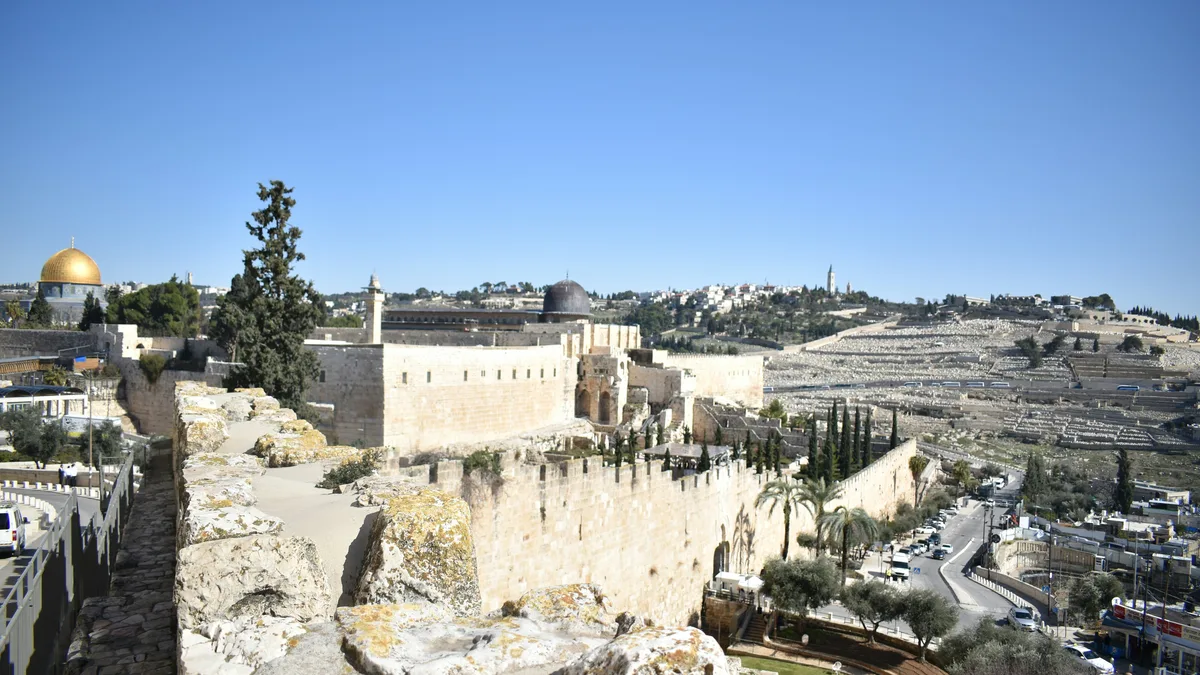
2 Chronicles 3 tells the history of King Solomon and his work to build the temple. He builds it atop Mount Moriah. In Jerusalem.
The place where Abraham led his only son to be sacrificed…
The place Isaac carried the wood for the sacrifice…
The place where the only son was obedient and silent…
It was Jerusalem. It was one of the mountains that surrounds the Holy City.
Academically there is no way to say what specific area, what specific mountain, or what specific place Abraham bound Isaac and prepared to sacrifice him. But we know that it was in the area where Jerusalem sits today and where Jerusalem sat 2,000 years ago. We can say, definitively, that Isaac and Jesus carried the wood of their sacrifices in the same general area.
The dress rehearsal of our salvation happened within a stone’s throw of the real thing. Isaac was bound and laid on the altar near the place where the King ascended to his throne—the cross. It is worth reflecting on the ram that was caught in a thicket was the precursor to the Lamb with a twisted thicket of a crown resting on his head.
Abraham utters the Hebrew word Hineni (Here I am) 3 times in this chapter. This Hebrew word is used to express a total surrender and complete availability to the Lord. It is to express one’s full openness and obedience to God. It expresses a closeness with the Almighty. To use these words is considered one of the holiest things a human can utter—it is a full devotion, confidence, and willingness to the Lord. Abraham uses this word 3 times in this chapter.
This contrasts with the words of Jesus from the cross. “My God, My God, why have you forsaken me…” is Jesus quoting Psalm 22. It is the near opposite of Hineni. It declares a graven distance, not an absolute closeness. In this, Jesus laments abandonment. This is the heartbreak of Good Friday. More than the torture; the exposure and humiliation of the cross; the excruciating pain of suffocation. Jesus endured a depth of pain and sorrow in the abandonment that we will never taste..
His forsakenness is how we can faithfully respond—Here I am.
How will you pray “Here I Am” this week in a way that calls you to take a next step in faith?
Recent Posts
Easter Foreshadowed
“After these things, God tested Abraham and said to him, ‘Abraham!’ And he said, ‘Here I am.’” Genesis 22:1 Last…

The Plant and the Payoff
“They shall come and proclaim his righteousness to a people yet unborn, that he has done it.” Psalm 22:31 “Even…
Sunrise Easter Reflection
Darkness was over the face of the deep… That’s what was there at the beginning. Darkness. Chaos. Empty. Nothing. This…

Rescue Mission
If the Son sets you free, you will be free indeed. John 8:36 Earlier this week, the crowds shouted, “Hosanna…

The Plant and the Payoff
"They shall come and proclaim his righteousness to a people yet unborn, that he has
Rescue Mission
If the Son sets you free, you will be free indeed.
John 8:36
Earlier this week, the
The Lion's Roar
And one of the elders said to me, “Weep no more; behold, the Lion of the tribe
Turn to the Lord
From that time, Jesus began to preach, saying, “Repent, for the kingdom of heaven is at
Overcome
“Then Samuel took a stone and set it up between Mizpah and Shen and called
Plot Twists
“Do not think that I have come to abolish the Law or the Prophets; I have
Conduit
“And I will make of you a great nation, and I will bless you and
Love Foreshadowed
“I will tell of the decree: The Lord said to me, “You are my Son;
The Crowd
“On one occasion, while the crowd was pressing in on him to hear the word
From The Start
"In the Beginning…”
Genesis 1:1
In yesterday’s gospel reading, Jesus tells the crowd that he has come