For Christ also suffered once for sins, the righteous for the unrighteous, that he might bring us to God.”
1st Peter 3:18
Getting soldiers from here to there is a huge part of military strategy. Historically, military victories hinge less on the number of soldiers and more on the ability to keep our forces equipped, fed, and reinforced. This is logistics. It is about transporting troops and supplies, coordinating supply chains, and rapidly responding to ever-changing conditions on the front lines.
Combat engineers are the soldiers at the front lines of these logistical efforts. Where there is no way, combat engineers make a way. When a field is covered in landmines, these brave soldiers clear and nullify the deadly ordinances. Where there are no roads, these soldiers make them. They build airfields, fortifications, and bridges. Their work is to enable the forward movement of soldiers, supplies, and vehicles to aid in the war effort.
It was the 291st Engineer Combat Battalion that rebuilt the streets and bridges of Normandy after D-Day. German forces destroyed and weakened these as they fled Normandy. It was this battalion that rebuilt the roads and reinforced the bridges so that tanks and more could further the advance.
Of course, the Engineer Combat Battalion wasn’t always close by—and building bridges for tanks isn’t necessary if you are trying to advance a small unit of 20 soldiers. Army Rangers are taught a different method to advance across a fast-moving stream or river.
One-Rope Bridges are the method of choice for these small units where speed is essential and disruption is to be avoided. If rangers are in advanced territory, the sound of heavy machinery is not conducive to crossing a river.
If you can get a rope across, you can build a bridge. If you can get a rope across, you can get the whole unit across.
This is the One-Rope Bridge. And it starts with a light pilot line and a designated swimmer. You read that right. A brave and strong swimmer is anchored in safety lines and has the pilot line. Braving the water and the rapids, this swimmer enters the current and makes their way across.
Why? Because if you can get a rope across, you can build a bridge.
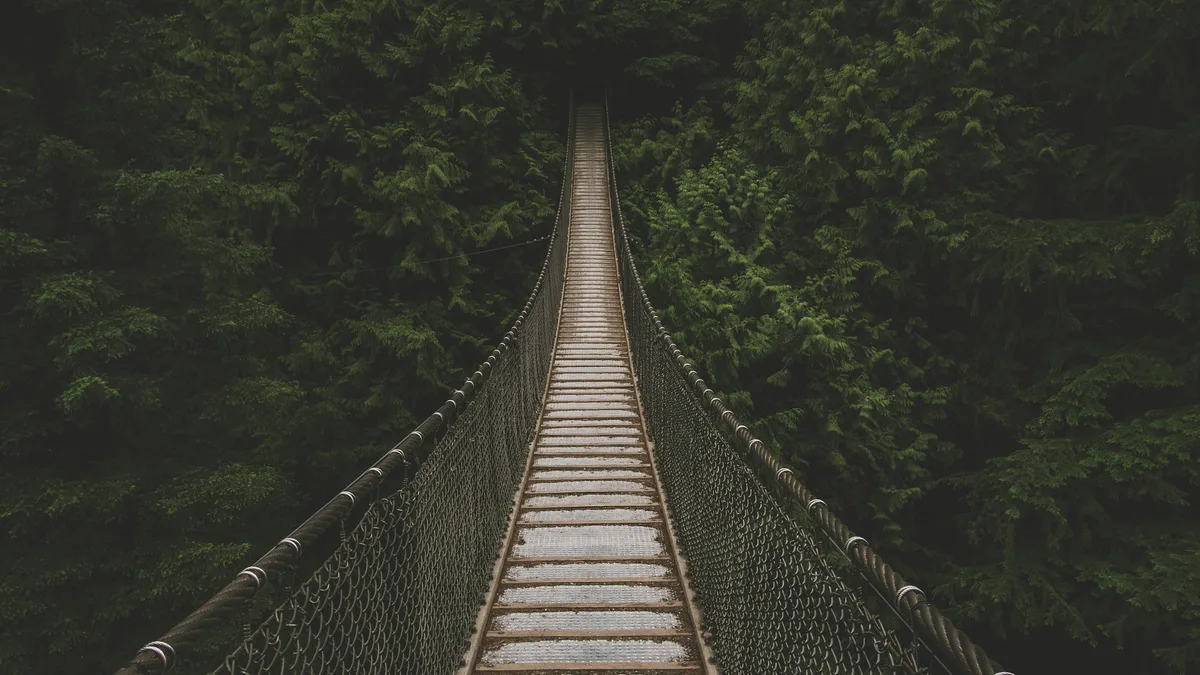
Once on the other side, with the pilot line anchored in, the suspension bridge begins to take shape. And, moment by moment, the team makes their way across the expanse.
This is Jesus. The chasm between our brokenness and God’s righteousness is wider than any river. It is an insurmountable gap that you and I will never be able to cross on our own. We can never swim through these dividing waters. We can’t walk around or look for a place where the gap narrows and the water slows. No, the expanse is too great and too dangerous.
But, not for Jesus. In his suffering and death, Jesus descends into hell. There he crashes through the gate of hell and crushes the evil one under his feet. He then walks to the other side of the chasm and is raised to new life on the other side. This is the Promise Land. This is the land we have been looking and longing for our whole lives. And Jesus leads the way.
He’s the first one to cross the gap—pun intended. His cross becomes the bridge for you and for me. Why, because if you’ve got someone brave enough to get to the other side, you can get the whole unit across.
Jesus is our savior. He is the one who leads the way—all the way. In him, we have hope and a future. In him, we too have a way across the gap. Not because we get it right. Nope. We have a way across because He allows us to hook into his life-saving rope. And, because of Him, we can walk the bridge to the Promised Land.
If you can get a rope across, you can get across. Thank you, Jesus!
What is the gap in your life that seems insurmountable—and how has Jesus crossed that chasm?
Recent Posts
Easter Foreshadowed
“After these things, God tested Abraham and said to him, ‘Abraham!’ And he said, ‘Here I am.’” Genesis 22:1 Last…

The Plant and the Payoff
“They shall come and proclaim his righteousness to a people yet unborn, that he has done it.” Psalm 22:31 “Even…
Sunrise Easter Reflection
Darkness was over the face of the deep… That’s what was there at the beginning. Darkness. Chaos. Empty. Nothing. This…

Rescue Mission
If the Son sets you free, you will be free indeed. John 8:36 Earlier this week, the crowds shouted, “Hosanna…
The Plant and the Payoff
"They shall come and proclaim his righteousness to a people yet unborn, that he has
Rescue Mission
If the Son sets you free, you will be free indeed.
John 8:36
Earlier this week, the
The Lion's Roar
And one of the elders said to me, “Weep no more; behold, the Lion of the tribe
Turn to the Lord
From that time, Jesus began to preach, saying, “Repent, for the kingdom of heaven is at
Overcome
“Then Samuel took a stone and set it up between Mizpah and Shen and called
Plot Twists
“Do not think that I have come to abolish the Law or the Prophets; I have
Conduit
“And I will make of you a great nation, and I will bless you and
Love Foreshadowed
“I will tell of the decree: The Lord said to me, “You are my Son;
The Crowd
“On one occasion, while the crowd was pressing in on him to hear the word
From The Start
"In the Beginning…”
Genesis 1:1
In yesterday’s gospel reading, Jesus tells the crowd that he has come